
Social discovery, AI research, and why destination forecasting needs leading indicators.
Travel SEO has a timing problem.
Most of the data we use for planning becomes useful once somebody has already decided that a destination is worth investigating.
Search volume tells us how many people are looking for holidays in Albania. Google Trends shows whether interest is moving. Search Console tells us whether we are capturing any of it. Booking data eventually tells us whether that interest was commercially useful.
All of those are valuable inputs, but by that point Albania is already in the consideration set.
The more interesting question is how it got there.
Destination demand increasingly starts somewhere else
Public First's 2026 research into TikTok's UK economic impact contains a few travel numbers worth paying attention to.
Among UK TikTok users surveyed:
- 28% said they had visited another UK town or city after seeing it on TikTok
- 22% said they had visited another country on holiday
- 21% had sought out a particular café or restaurant in another UK town or city
- 17% had explored a new area of their own city
Public First also estimates that TikTok influenced 2.3 million additional visits to UK towns, cities and attractions in 2025.
What the research does support is a point that matters for travel SEO:
Destination demand can start forming well before it becomes visible as Google search demand.
Other research points in the same direction.
Expedia Group's 2025 Traveller Value Index found that 61% of consumers used social media for travel inspiration, up from 35% in its previous study. It also found that 73% said influencer recommendations had affected a decision to book a trip or travel component.
Skyscanner's 2026 research reports TikTok as the most popular source of travel inspiration among UK Gen Z respondents, at 59%.
Different studies, audiences and methodologies mean I wouldn't spend too much time comparing the percentages directly.
The behaviour is more interesting than the exact number.
The Google search may be halfway through the journey
Take Albania.
Someone sees a creator posting from Ksamil. Albania wasn't on the list of destinations they were considering, but they save the video.
A few days later another one appears. They send it to their partner.
Then the searches start:
Albania holiday
best beaches Albania
Ksamil hotels
After that they might see an AI Overview, ask ChatGPT whether Albania is suitable in May, read Reddit threads, browse Booking.com, watch a couple of YouTube videos and eventually book.
SEO reporting is very good at describing the part of the journey that begins around here:
Google query → organic visit → booking
It is less good at explaining why that query existed in the first place.
TikTok may never appear in the conversion path. Google may get the organic session. An AI assistant may influence the shortlist. An OTA may take the transaction.
They can all contribute without doing the same job.
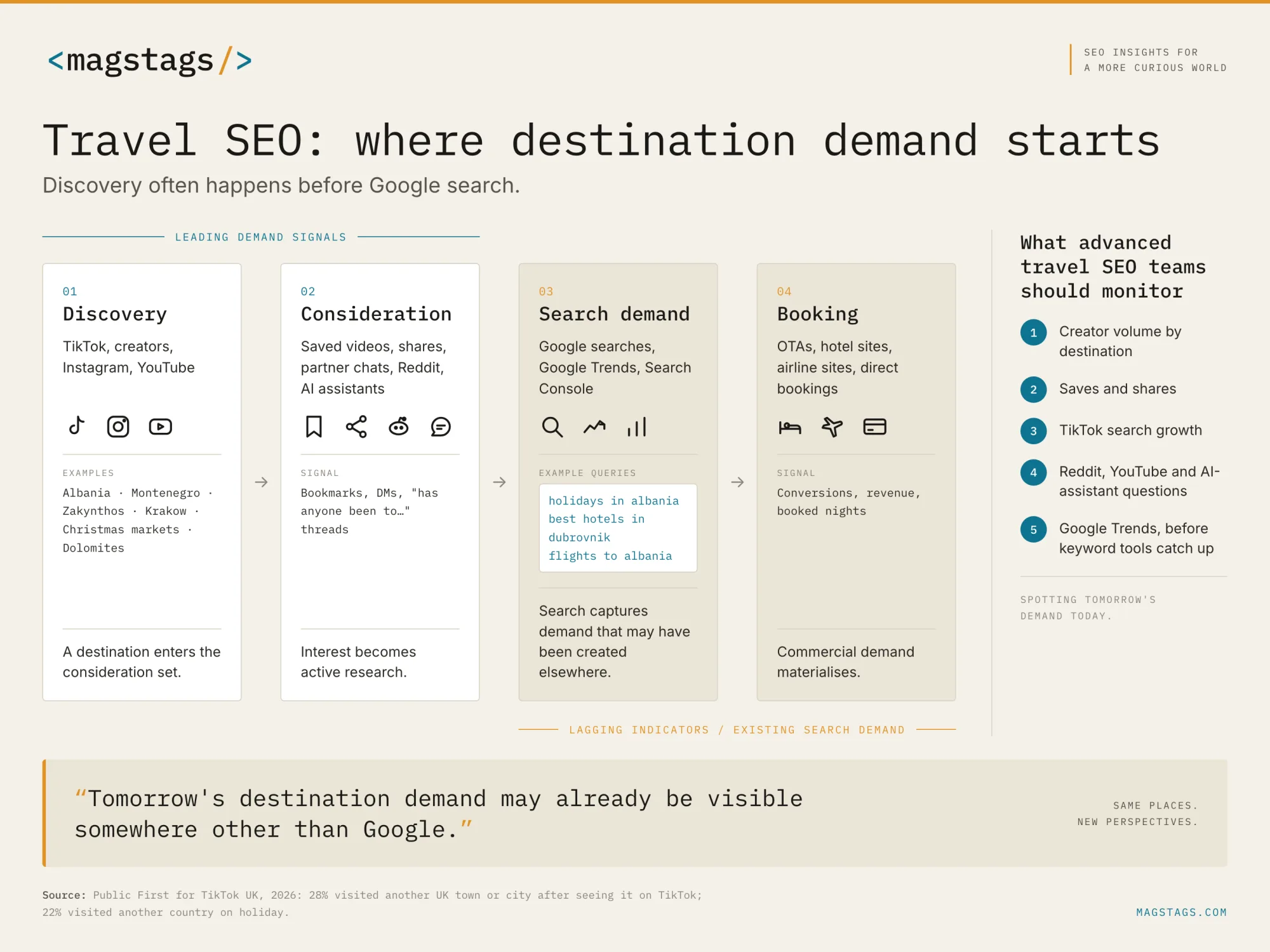
For travel brands, that distinction matters.
Our forecasting models are mostly built on demand that already exists
A typical travel SEO opportunity model uses some combination of:
- monthly search volume
- seasonality
- previous-year performance
- current rankings
- expected CTR
- conversion rate
- booking value
I use these inputs too. When you have thousands of destinations, routes or properties to prioritise, you need data that is measurable and reasonably comparable.
The trade-off is that these signals are mostly backward-looking.
Imagine a destination with fairly modest search demand today.
Creator coverage starts increasing. Videos are attracting unusually high save and share rates. Reddit discussions become more frequent. YouTube coverage grows. Interest within social platforms starts to build.
Then Google Trends begins to move.
Eventually the standard keyword datasets show a meaningful increase as well.
At that point, a competitor may already have expanded its destination content, improved inventory coverage, built commercial pages, commissioned creator activity and picked up links and mentions around the destination.
There was nothing wrong with the keyword data. It simply became useful later in the curve.
That is the bit I think travel SEO teams need to get better at.
Travel SEO needs a demand intelligence layer
I wouldn't replace keyword research with TikTok trend watching. That would create a completely different set of problems.
I would add an earlier layer to the planning process.
For example:
| Signal | What I would use it for |
|---|---|
| Creator coverage increasing | Early indication that destination awareness may be growing |
| Social search and destination activity | Signs that discovery is becoming more active research |
| Saves and shares | A stronger consideration signal than passive views alone |
| Reddit and community discussion | Travellers beginning to ask more specific planning questions |
| YouTube destination research | Evidence of deeper research behaviour |
| Google Trends | Interest beginning to appear in conventional search |
| Search Console query growth | Our own visibility starting to capture the change |
| Internal site search and browsing | First-party evidence of destination interest |
| Bookings and revenue | Confirmation that interest has commercial value |
Not every business will have clean access to every signal, and I wouldn't pretend social or community data has the consistency of Search Console.
The aim is not to build another giant dashboard.
I would be looking for several indicators beginning to move in the same direction. That is when a destination becomes worth investigating.
It does not automatically need a new SEO content programme. It needs someone to work out whether the change is real, relevant to the business and commercially useful.
I would split destination opportunity into three buckets
This is probably the simplest way I would incorporate these signals into an existing travel SEO process.
Established demand
These are destinations with meaningful, proven search demand.
They still deserve conventional SEO modelling around market size, rankings, CTR, conversion rates and commercial value.
For most travel businesses, this group will continue to account for a large proportion of SEO investment.
Growing demand
These are destinations where search behaviour is already accelerating.
Google Trends, paid-search queries, Search Console, internal searches and first-party site behaviour can help identify growth that may not yet be obvious in annualised keyword volumes.
If the commercial fundamentals are there, these destinations may justify moving planned work forward.
Emerging demand
This is the more interesting group.
The signals are appearing further upstream.
Creator activity is increasing. Social discussion is picking up. Travellers are asking more questions on Reddit. A destination starts appearing repeatedly in travel media. Perhaps airline capacity has increased or new routes are opening.
At this point I would not ask how many SEO pages we should create.
I would ask whether something meaningful is actually happening.
For an emerging destination, I would want to know:
- Is interest spread across multiple sources or driven by one viral post?
- Is conventional search behaviour beginning to follow?
- Is there enough relevant flight capacity?
- Do we have accommodation, activity or product inventory?
- Does the audience resemble our customers?
- Can we compete on price and availability?
- Is the trend sustained rather than disappearing after a couple of weeks?
That is a much more useful application of social data than deciding that the SEO team now needs to own TikTok.
Demand creation and demand capture are not the same thing
This also creates a measurement problem.
Suppose TikTok introduces somebody to Albania.
Two weeks later they search Albania holidays, visit through an organic result and eventually book.
Organic search may correctly receive the conversion in analytics. That tells us something useful about where the booking was captured.
It does not necessarily tell us where the destination entered consideration.
I find it useful to separate three parts of that journey.
Demand creation
What introduced the destination in the first place?
Social platforms, creators, publishers, PR and increasingly AI recommendations can all play a role.
A traveller asking an AI assistant for somewhere warm and inexpensive in Europe in May may discover a destination they had never intended to search for.
Demand influence
What helped the traveller research, validate and narrow down the choice?
Google results, AI Overviews, ChatGPT, Reddit, YouTube, review sites, publishers and OTAs can all contribute here.
Demand capture
Where did the traveller eventually take a commercially meaningful action?
That may still be an organic Google result. It could also be an OTA, a hotel or airline site, a paid result, an AI referral or a direct visit to the brand.
The point isn't to find one channel that deserves all of the credit.
It is to understand that a channel report and the process by which demand was created are increasingly two different things.
What I would actually change in a travel SEO workflow
I don't think SEO needs to absorb social, PR, creators and every other discovery channel.
SEO still has a clear job.
What I would change is the range of signals used when deciding which destinations deserve attention.
For a large travel business, I would want destination planning to bring together four broad groups of data:
- Search signals: Google Trends, paid-search queries, Search Console and keyword demand.
- First-party signals: internal site search, destination-page behaviour, availability searches and bookings.
- Discovery signals: TikTok, Instagram, YouTube, Reddit, creator activity and travel media.
- Commercial signals: inventory, flight capacity, availability, margin and the ability to compete in the market.
Someone then needs to join those signals up.
That does not necessarily need to be the SEO team, although SEO should be part of the conversation.
The practical outcome could be quite simple: a regular review that identifies a small number of destinations where emerging external signals are strong enough to justify deeper analysis.
Those destinations can then enter the normal process: SERP analysis, demand sizing, inventory assessment, content planning and forecasting.
The difference is that the team gets a chance to investigate the opportunity earlier.
In large travel sites, where prioritisation is often as difficult as the SEO itself, I think that matters.
Opportunity models naturally favour markets that already have large and measurable search demand. That is usually rational. But it also means an emerging destination can look commercially insignificant until fairly late in its growth curve.
Adding earlier demand signals gives us another way to challenge that assumption.
Search volume is useful. It just isn't early.
Google remains hugely important in travel research and booking. I don't see much value in another argument about TikTok replacing Google.
That isn't what I think is happening.
A creator might introduce the destination. Social content can make it desirable. AI might put it onto a shortlist. Reddit can help validate the decision. Google may handle a large part of the research, and an OTA, airline, hotel or travel brand eventually captures the booking.
Search volume remains one of our best indicators that meaningful search demand exists.
It just isn't always the first place a change in destination demand becomes visible.
For travel SEO, the competitive advantage may therefore sit slightly earlier in the planning process than it used to.
We still need to be very good at answering the searches that exist today.
But I would increasingly ask another question when deciding where to invest next:
Can we spot where destination demand is moving before the keyword tools tell everyone else it has already moved?
Sources
- Public First: TikTok's UK economic impact, 2026. Anonymous UK consumer survey of 4,158 adults plus separate business and creator research. Commissioned by TikTok.
- Expedia Group: 2025 Traveler Value Index.
- Skyscanner: Gen Z travel statistics, 2026.